

Built For Brains
This is how we redesign work so it actually makes sense
Most workplaces are designed as if everyone processes pressure the same way.
They don’t.
the gap
People process pressure differently. Some need thinking time. Some think out loud. Some cope with ambiguity. Others need clearer edges.
None of that is weakness. It is how brains work.
When work ignores that, strong people compensate. They carry invisible load, fill gaps and smooth friction.
It works for a while. Until it does not.
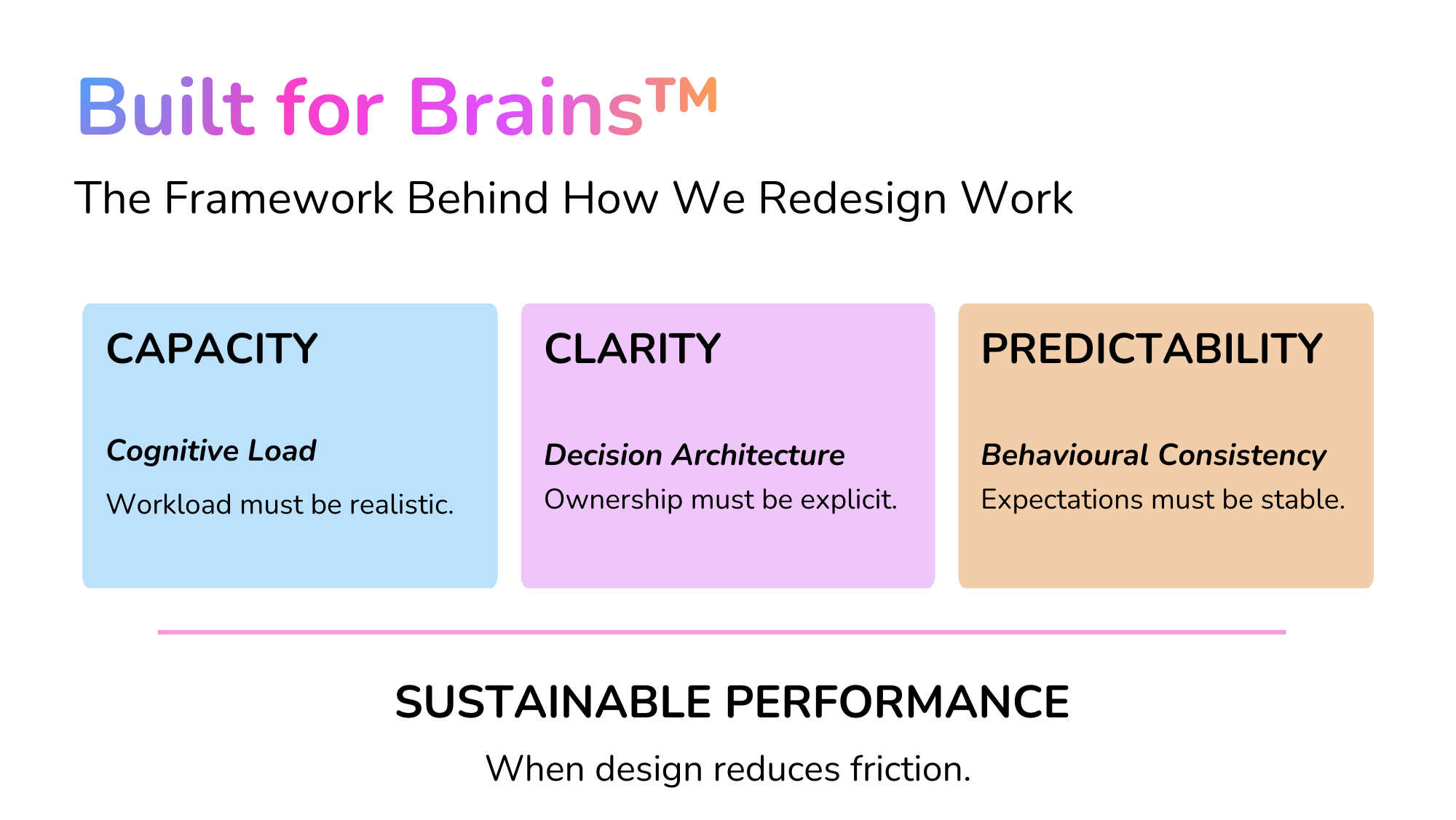
The Model
Built for Brains™ focuses on three design pressures that determine
whether teams steady or strain.
-
Cognitive Load
Working memory is finite. When demand exceeds capacity, performance relies on effort rather than structure.
Context switching accumulates. Mental tabs remain open. Unseen work compounds.
The issue is not resilience. It is workload design.
Key question: Is the workload realistically manageable?
-
Decision Architecture
Ambiguity consumes energy. When five people give five different answers to what matters most this week, friction is already present.
Unclear ownership drives repetition. Unclear standards drive anxiety. Unclear priorities drive delay.
Clarity reduces noise and restores momentum.
Key questions: Who decides? What does good look like?
-
Behavioural Consistency
Uncertainty triggers threat response. Shifting expectations, implied rules and inconsistent accountability drive people to self-protect.
Self-protection reduces challenge, creativity and candour.
Predictability supports steadier performance.
Key question: Are expectations explicit and consistent?
Built in Practice
Built for Brains™ did not emerge from a brainstorm. It emerged from patterns.
Over 1,500 hours of one-to-one support across 50 organisations and thousands of leaders and learners in multiple sectors and countries revealed the same friction.
Capable people carrying invisible load. Decisions looping because ownership was unclear. Performance dipping when expectations shifted without warning.
The pattern was consistent. When workload, ownership and expectations lack clarity, performance becomes effort-driven instead of structure-led.
Grounded in Research
The framework is grounded in established research, not opinion.
It integrates evidence from cognitive load, working memory, decision fatigue, role ambiguity and psychological safety research.
Across these disciplines, the message is consistent: performance problems are rarely about motivation. They are usually about design.
Built for Brains™ turns that evidence into practical work design leaders can use.
Why It Matters
This is not about pushing people harder. It is about reducing unnecessary friction so capable teams can perform without burning out.
When capacity is realistic, clarity is sharp and expectations are consistent, performance improves naturally. Not because people toughen up, but because the structure supports them.
If This Sounds Familiar
If your team is busy but nothing feels lighter, strong staff are compensating and decisions loop more than they land, start with design.