
Why Your Brain Feels Broken at Work
(It Isn't. But Here's What Actually Is.)

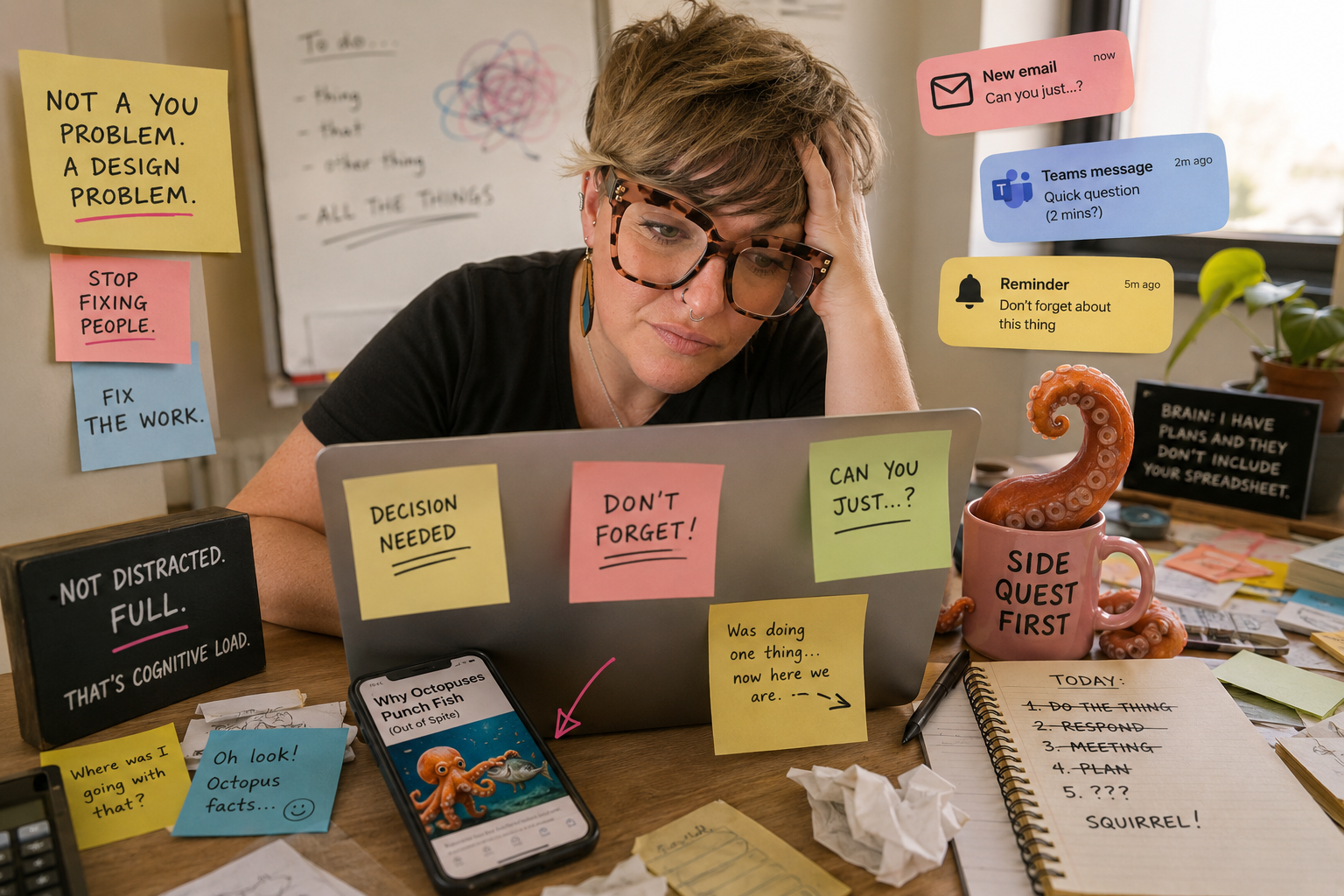
I spent twenty minutes trying to do one task...
...and ended up reading about octopuses punching fish out of spite.
Not metaphorically. Actual octopuses.
Apparently they do it when they're bored or irritated. Scientists call it redirected aggression.
I call it relatable.
The thing I was supposed to be doing? Still on the screen. Untouched. My brain had packed a bag and gone on a full side quest without telling me.
And here's the bit that mattered.
I'm not someone who struggles to focus. Military. Aviation. Senior leadership. I know how to concentrate when it counts.
So why couldn't I do one simple task?
It's not focus.
It's fragmentation.
Why cognitive load looks like a focus problem
Before I'd even opened the task, three messages had landed.
A question needing a decision. A reminder about something unfinished. A "quick" request that wasn't.
None of them urgent. All of them now living in my head, taking up space.
So when I opened the actual work… my brain was already full.
Not distracted. Full.
That's cognitive load. And when your brain is full, it doesn't say "I'm at capacity."
It just... wanders.
Finds something easier.
Redirects.
Like an octopus punching a fish.
Heres the issue with this…
When it looks like a focus problem, we fix it like a focus problem.
Time management training.
Resilience workshops.
"Have you tried blocking your calendar?"
We fix the person.
When the actual problem is how the work is designed around them.
That's work design.
It's also the bit most UK organisations are missing.
“We call this resilience. I call it overcompensating.”
What task-switching actually costs you and Your team
Every time you switch tasks — properly switch, not just glance — your brain pays a cost.
Stop → Reset → Where was I? → What was I doing? → Right OK → Back in. (Maybe)
Research puts full recovery at around 23 minutes after a single interruption.
Now count how many times that happens in your team's day.
If you're running a modern workplace — open comms, multiple platforms, a culture of "quick questions" — your people might never reach full focus at all!
Which means… They're not doing their jobs.
They're doing forty fragments of their jobs, stitched together with willpower and caffeine, and hoping no one notices it's taking longer than it should.
Then we call it a motivation problem.
We start fixing people who were never the problem.
The people aren't broken.
The work is.
The pattern I kept seeing across organisations
When I started coaching people — not fixing, just listening, guiding — the same sentence kept coming up.
Different people. Different roles. Different sectors.
"I know how to do my job. I just don't know what's happened to me lately."
Quiet. Not dramatic.
Like something had slowly stopped working and they couldn't find the fault.
Guess what… Every single time I looked underneath it… it wasn't them. (Gasp!)
It was their day.
The way work was built around them.
The way information landed.
The way decisions were made… or, more often, weren't.
The way they were expected to hold twelve things in their head while still producing quality work.
Same pattern, every time:
→ Unclear expectations that made simple tasks complicated
→ Interruptions that restarted the cognitive clock
→ Systems creating more work than they removed
→ Decisions that never quite landed, so people second-guessed everything
Not one big problem. Lots of small ones. Stacked.
Stacked problems don't feel like design failures.
They feel like personal ones.
That's the trap.
Why work gets harder as teams scale
Here's the part nobody warns you about.
At 10 people, work is simple. Everyone knows what's happening. Decisions get made in real time.
At 20, it stretches.
At 30–40, it changes properly.
Work starts moving across teams, through layers of management, between different interpretations of the same brief.
People aren't just doing their jobs anymore.
They're constantly figuring out who owns what, what done actually means, whether their version of the priority matches anyone else's.
Nobody put that in their job description.
Nobody's measuring it. Nobody's even named it.
But it's happening every day. In the background. Costing energy.
This is invisible load and it's already compounding.
Here's what it sounds like from a manager's seat:
"Our best people just can't keep up anymore."
Not the ones coasting. The proper good ones…
The manager isn't wrong.
Something has shifted but it's not in the people. It's in the work around them.
The organisation grew. Nobody redesigned how work flows through it.
That's a work design problem.
And it's fixable.
Signs you've got a work design problem, not a people problem
If it's one person struggling, it might be performance. If it's more though…
Look for the pattern:
→ Multiple capable people hitting the same wall at the same time
→ Managers handling the same situations differently — not badly, just differently
→ Decisions reopening after they've been made
→ You becoming the default answer to questions that shouldn't need you
→ Effort consistently higher than output suggests it should be
That's not a coincidence.
That's not a bad hire.
That's what work looks like when the structure hasn't kept up with the scale.
What work design actually changes
When work is designed properly — expectations explicit, decisions sitting where they should, information arriving in a way that makes sense — cognitive load drops.
People stop spending energy figuring out what they're supposed to be doing and start actually doing it.
They stop second-guessing. Stop double-checking. Stop ending the day busy but empty.
They get their thinking back.
And the people who looked like they were struggling? Stop struggling.
Not because they changed.
Because the environment did.
That's sustainable performance.
And it's achievable without burning anyone out to get there.
The question every leader should be asking
If you've spent any time recently thinking:
"Why is this so hard when I know I can do it?"
That thought is information.
It's telling you something's not right with the work around you.
Not with you.
If you lead a team where good people are quietly going backwards, don't reach for the obvious fixes first…
Reach for the right question.
Does the work actually make sense anymore?
Because more often than not, the answer is no, but it's fixable.

White ceramic mug with the Inclusive Minds UK (IMUK) logo sits on a tidy wooden desk, filled with coffee. Surrounding the mug are a notebook with a pen resting on it, a small potted plant, and neatly stacked stationery, with a softly blurred, calm workspace in the background.
Not sure where to start?
The Capacity + Clarity Self-Check is a good first step.
Five focused questions. Less than 10 minutes. Helps you see whether the pressure is structural or personal before you do anything else.
Already clear it's a work design problem?
We will look at what’s actually getting in the way.
→ Book a 20-minute discovery call
Upcoming: Make Work Make Sense in person Day
Busy doesn't automatically mean productive.
If work feels harder than it should...
If your team are flat out but somehow still stuck...
If good people are spending more time managing work than actually doing it...
Come spend a day figuring out why.
Make Work Make Sense — Barnsley — July
A practical day for leaders, SMEs and organisations who are done firefighting and ready to understand what work design actually means.
You'll leave with practical actions, clearer thinking, and a proper understanding of what's creating friction in your work.
Early bird £95, then it goes up to £137
Venue announcement coming soon.
→ DM or COMMENT BARNSLEY to get first dibs when booking opens.
Written by Ria Jackson — Founder of Inclusive Minds UK.
IMUK works with organisations to redesign how work actually works.
Because it isn't the people.
It's the design.
#MakeWorkMakeSense #Neuroinclusion #InclusiveWorkDesign #WorkDesignUK #NeurodivergentEmployees #CognitiveLoadAtWork #InclusiveWorkplaceUK
